Wednesday, November 02, 2011


See Explanation.  Clicking on the picture will download
 the highest resolution version available.2011 October 31 
Ghost of the Cepheus Flare 
Image Credit & Copyright: Adam Block, Mt. Lemmon SkyCenter, University of Arizona
Explanation: Spooky shapes seem to haunt this starry expanse, drifting through the night in the royal constellation Cepheus. Of course, the shapes are cosmic dust clouds faintly visible in dimly reflected starlight. Far from your own neighborhood on planet Earth, they lurk at the edge of the Cepheus Flare molecular cloud complex some 1,200 light-years away. Over 2 light-years across the ghostly nebula and relatively isolated Bok globule, also known as vdB 141 or Sh2-136, is near the center of the field. The core of the dark cloud on the right is collapsing and is likely a binary star system in the early stages of formation. Even so, if the spooky shapes could talk, they might well wish you a happy Halloween.

Labels:

Wednesday, October 26, 2011

The Cosmos' Greatest Mystery Deepens

Dark Matter, Darker Still: The Cosmos' Greatest Mystery Deepens

The galaxy of Andromeda, the nearest large galaxy to our own, circa 1990

Space Frontiers / Hulton Archive / Getty Images

Like Hollywood legends Audrey Hepburn and Katharine Hepburn, dark energy and dark matter are completely unrelated, even though they share a name. Dark energy, a force that makes the universe expand faster and faster all the time, is called dark because it's mysterious. Nobody knows what it is. Dark matter, on the other hand, a type of matter that outweighs ordinary stars and galaxies 5 to 1, is called dark because it's utterly invisible. We know it's there because its gravity yanks galaxies and stars around, but it neither emits nor reflects any light.


Labels:

HH-222: The Waterfall Nebula

Astronomy Picture of the Day

Discover the cosmos! Each day a different image or photograph of our fascinating universe is featured, along with a brief explanation written by a professional astronomer.

2011 October 24
See Explanation.  Clicking on the picture will download  the highest resolution version available.

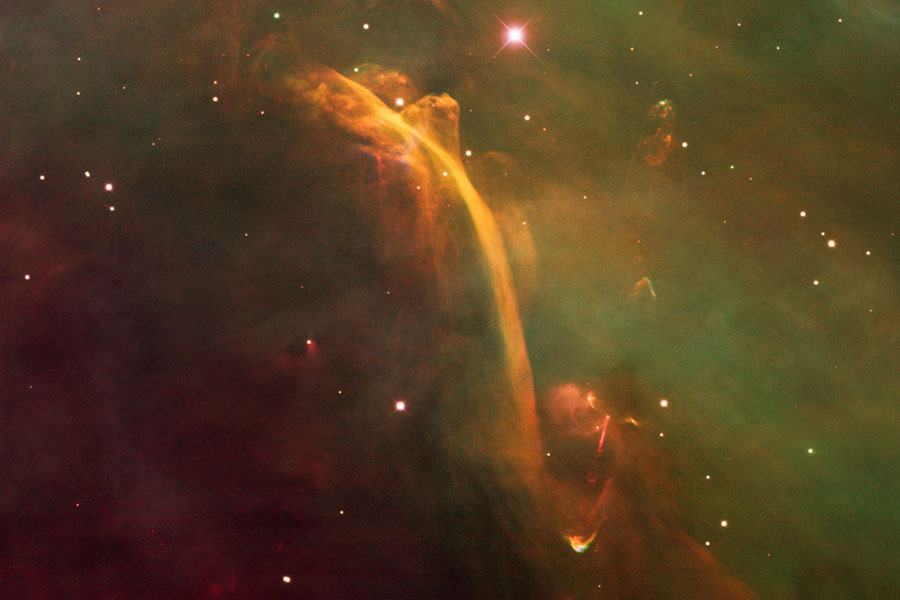
HH-222: The Waterfall Nebula
Image Credit: Z. Levay (STScI/AURA/NASA), T.A. Rector (U. Alaska Anchorage) & H. Schweiker (NOAO/AURA/NSF), KPNO, NOAO

Explanation: What created the Waterfall Nebula? No one knows. The structure seen in the region of NGC 1999 in the Great Orion Molecular Cloud complex is one of the more mysterious structures yet found on the sky. Designated HH-222, the elongated gaseous stream stretches about ten light years and emits an unusual array of colors. One hypothesis is that the gas filament results from the wind from a young star impacting a nearby molecular cloud. That would not explain, however, why the Waterfall and fainter streams all appear to converge on a bright but unusual non thermal radio source located toward the upper left of the curving structure.Another hypothesis is that the unusual radio source originates from a binary system containing a hot white dwarf, neutron star, or black hole, and that the Waterfall is just a jet from this energetic system. Such systems, though, are typically strong X-rays emitters, and no X-rays have been detected. For now, this case remains unsolved. Perhaps well-chosen future observations and clever deductive reasoning will unlock the true origin of this enigmatic wisp in the future.

Astronomers: What other "mysterious structures" appear on the sky?

Labels:

Saturday, February 05, 2011

Moon is getting further away


Why the Moon is getting further away from Earth

The Moon as seen at nightThe Moon is not only beautiful, it is vital to our ecosystems and wildlife

Related Stories

The speed at which the Moon is moving away from Earth could affect life on the planet, but this could take billions of years to happen, writes space scientist Dr Maggie Aderin-Pocock.
It's easy to take the Moon for granted, even on a clear night when it can light up the sky. It really feels as if it has always been there just as it is now, throughout history. But that's not strictly true.
It is thought that the Moon was formed when a proto-planet about the size of Mars collided with the early Earth around 4.5bn years ago. The debris left over from impact coalesced to form the Moon. Computer simulations of such an impact are consistent with the Earth Moon system we see in the 21st Century.
The simulations also imply that at the time of its formation, the Moon sat much closer to the Earth - a mere 14,000 miles (22,530.8 kilometres) away, compared to the quarter of a million miles (402,336 kilometres) between the Earth and the Moon today.

Labels:

Wednesday, December 17, 2008

Before the Big Bang


More Thoughts (and now math!) On What Came Before the Big Bang

Written by Nancy Atkinson

CMB Timeline.  Credit: NASA

CMB Timeline. Credit: NASA


Physicist Sean Carroll gave a wonderful talk at the June 2008 American Astronomical Society meeting about his "speculative research" on what possibly could have existed before The Big Bang. (Here's an article about Carroll's talk.) But now Carroll and some colleagues have done a bit more than just speculate about what might have come before the beginning of our Universe. Carroll, along with Caltech professor Marc Kamionkowski and graduate student Adrienne Erickcek have created a mathematical model to explain an anomaly in the early universe, and it also may shed light on what existed before the Big Bang. "It's no longer completely crazy to ask what happened before the Big Bang," said Kamionkowski.

Labels:

Saturday, November 08, 2008

Deepest Ultraviolet Image Shows a Sea of Distant Galaxies


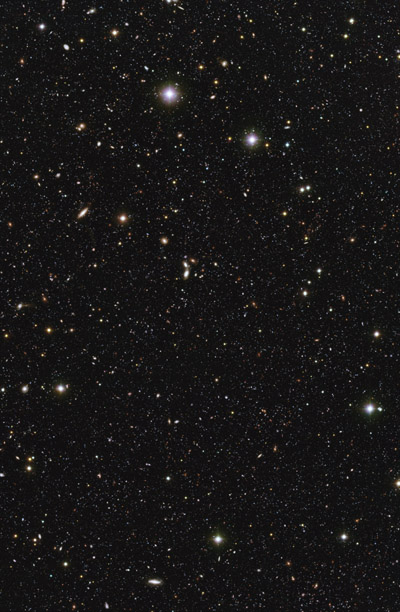
A Pool of Distant Galaxies.  Credit: ESO

A Pool of Distant Galaxies. Credit: ESO

Dive right in to this image that contains a sea of distant galaxies! The Very LargeTelescope has obtained the deepest ground-based image in the ultraviolet band, and here, you can see this patch of the sky is almost completely covered by galaxies, each one, like our own Milky Way galaxy, and home of hundreds of billions of stars. A few notable things about this image: galaxies were detected that are a billion times fainter than the unaided eye can see, and also in colors not directly observable by the human eye. In this image, a large number of new galaxies were discovered that are so far away that they are seen as they were when the Universe was only 2 billion years old! 
This image contains more than 27 million pixels and is the result of 55 hours of observation, made primarily with the Visible Multi Object Spectrograph (VIMOS) instrument. To get the full glory of this image, here's where you can download the full resolution version. It's worth the wait while it downloads. Or click here to be able to zoom around the image.

Labels:

Friday, November 07, 2008

Dark Matter

Are We Close to Finding Dark Matter?

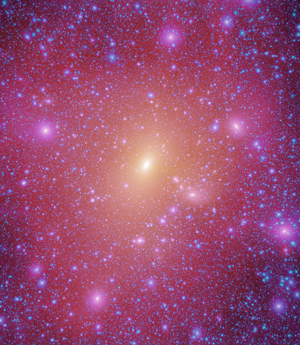
Dark Matter Halo. Credit: Virgo Consortium  
Scientists say he search for the mysterious substance which makes up most of the Universe could soon be at an end. A massive computer simulation was used to show the evolution of a galaxy like the Milky Way, and analysts were able to "see" gamma-rays given off by dark matter. Dark matter is believed to account for 85 per cent of the Universe's mass but has remained invisible to telescopessince scientists inferred its existence from its gravitational effects more than 75 years ago. If the computations are correct, the findings could help NASA's Fermi Telescope to search for the dark matter and open a new chapter in our understanding of the Universe. 
(...) 
Read the rest of Are We Close to Finding Dark Matter? (256 words)

Labels:

Monday, April 07, 2008

What is the biggest star in the Universe?

My six-year old daughter is a question asking machine. We were driving home from school a couple of days ago, and she was grilling me about the nature of the Universe. One of her zingers was this, "What's the Biggest Star in the Universe"? I had an easy answer, the Universe is a big place, and there's no way we can possibly know what the biggest star is. That didn't go over so well. So she refined the question. What's the biggest star that we know of?

Of course, I was stuck in the car, and without access to the Internet. But now I'm back at home, doing some research, and I thought I'd share the answer with the rest of you too.

Before we jump straight to the answer, let's take a look at our own Sun for a sense of scale. Our familiar star is a mighty 1.4 million km across (870,000 miles). That's such a huge number that it's hard to get a sense of scale. The Sun accounts for 99.9% of all the matter in our Solar System. In fact, you could fit one million planet Earths inside the Sun.

Labels: ,


View My Stats